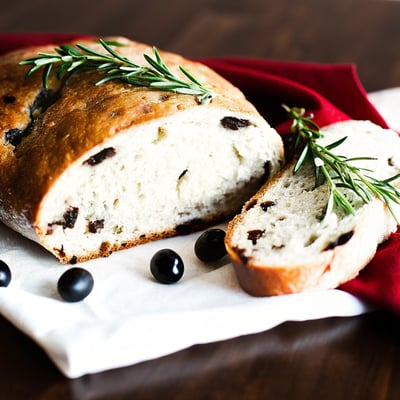
Rosemary Olive Sourdough Bread
Total Time
1 hour and 5 minutes
Prep Time
25 minutes
Cook Time
40 minutes
Rating
4.9 out of 5 stars
(46)
Ingredients
1 serving
- 4 cups organic white bread flour (520 grams) see notes
- 2 teaspoons sea salt (12 grams)
- 1/3 cup sourdough starter (use after it has peaked) 90 grams
- 1 7/8 cup water (385 grams)
- 3/4 cup chopped kalamata olives
- 2-3 tablespoons fresh rosemary, chopped
- 1/2 cup roasted whole garlic cloves (optional but good)
- rice flour for dusting (or sub regular flour)
How would you rate this recipe?
Preparation
Step 1
Read through and perfect
Step 2
the No-Knead Sourdough Recipe (watch the video there) I recommend not attempting this until you have mastered that recipe. 🙂
Step 3
Mix the dough
Step 4
At night, in a large bowl, mix flour and salt together. In a small bowl, mix starter and water together using a fork. Pour the starter-water into the flour mixture and stir with a fork until relatively combined. Using a wooden spoon, or dough mixer, scrape sides and mix dough for one minute, incorporating all the flour. The dough will feel thick and heavy and shaggy. Just do your best to incorporate all the flour. If for some reason the dough will not incorporate all the flour, add a tablespoon of water at a time to get it incorporated. Cover with a damp kitchen cloth, wait 15 minutes and do 2 sets of stretch and folds, 15 minutes apart. See video.
Step 5
RISE
Step 6
Let rise overnight on the counter 10-14 hours. 65F-70F is ideal. In the morning, the dough should have swelled, but not quite doubled. Do the poke test.
Step 7
Prepare your banneton dusting the banneton with rice flour and perhaps some olives and rosemary in the bottom ( which will end up being the top.) See notes for using a regular bowl.
Step 8
SHAPE
Step 9
Using a wet dough scraper, or wet fingers, loosen the dough around the edges and pour it onto a well-floured surface. Treat the dough gently, flattening lightly with your fingertips into a rough rectangle about 1 1/2 inches thick. It need not be perfect. Sprinkle the olives, rosemary and garlic over the surface. Using the dough scraper, lift up one side, stretching just a bit up and over to the middle, then fold up the other side, like a tri-fold envelope. You want the dough to be inbetween the filling so all the filling is not in one area. (See notes) Turn the dough horizontally. Let the dough rest for 10 minutes. Then repeat. Gently flatten with fingertips (it needn’t be as flat as the first time), then do another tri-fold. Pinch the seams closed and lift into the prepared banneton, seam side up.
Step 10
REST & PREHEAT
Step 11
Place dough in the fridge uncovered for 1 hour, while you preheat the oven to 500F (or 475F) with your lidded dutch oven inside.
Step 12
SCORE
Step 13
Pull the dough from the fridge and have your lame (or sharp knife or razor blade) ready to score. Place a piece of parchment over the banneton and flip the dough, setting down on the counter over the parchment. Score 3/4 -1 inch deep at a 45-degree angle- basically wherever you want the dough to puff up. One slash is fine, or create a design.
Step 14
Pull the Dutch oven oven from the oven and close the oven door. Remove the lid, place the scored dough into the Dutch oven, lifting it by the corners of the parchment. (See notes) Quickly cover and place back in the oven.
Step 15
BAKE
Step 16
Place in the middle of the oven for 20 mins with convection on, (or 25 minutes w/no convection ) or 28 minutes at 450F. Remove the lid, and the interior should reach 200F ( if not replace the lid until it does). Once 200F, uncover the bread, lower heat to 450F, and continue baking 10-15 minutes until deeply golden and internal temp reaches 204- 208F. No pale loaves please, let them get golden!
Step 17
COOL
Step 18
Remove from the dutch oven, let it cool 1 hour on a rack or tilted up on its side, before slicing so you don’t let the steam out and don’t smash it- be patient. This is the hardest part. 😉. Take a picture! Feel proud. You did it!
Step 19
Save recipe for the next time?